
Creating Spaces That Support Wellbeing
Simple Home · 8 min read · Published 10 August 2026
Our homes quietly shape the way we feel.
They influence how easily we wake up, how well we focus, how often we connect with the people around us, and how easily we rest. Yet many of us live in spaces that have slowly become overwhelmed — not because we’ve done anything wrong, but because life has been busy. Children grow, work follows us home, belongings accumulate, and routines change.
If you’ve ever walked into a room and immediately felt mentally tired, you’re not imagining it. Our surroundings can affect stress, attention and emotional wellbeing in ways we don’t always notice until they begin to weigh on us.
The encouraging news is that creating a home that supports wellbeing doesn’t require a complete makeover or a perfectly organised house.
Often, the smallest changes can make a meaningful difference.
At Home Heart Growth, we believe our homes don’t need to impress anyone. They simply need to support the people who live there.
Why Our Environment Matters More Than We Think
Research in environmental psychology suggests that aspects of our physical surroundings can influence stress and psychological wellbeing. Factors such as noise, crowding, housing conditions and our sense of control over our environment can all affect how we experience the places around us.
When a space feels chaotic or constantly demands our attention, it can add to our mental load. When it feels simple, predictable and welcoming, it can be easier to settle, focus and recover from everyday demands.
This isn’t about creating a minimalist show home.
It’s about removing unnecessary friction so life becomes a little easier to navigate.
Think about the difference between searching for your keys every morning and always knowing where they belong. Or sitting down in a corner that feels peaceful instead of being surrounded by unfinished tasks.
These small experiences quietly shape how a home feels.
A Wellbeing Space Looks Different for Every Family
There is no universal blueprint for a peaceful home.
A family with young children may need something very different from someone living alone. A small apartment can feel more restorative than a large house if it supports the rhythms of the people living there.
Rather than asking:
How should my home look?
it may be more helpful to ask:
- Does this space help us feel calmer?
- Does it make daily routines easier?
- Does it encourage rest, connection or focus?
- Does it support the life we want to live?
A supportive home is not about following someone else’s idea of what a home should be.
It’s about creating an environment that works with the people who live there.
Create Calm Through Simplicity
One of the simplest things many people find helpful is reducing unnecessary visual and practical clutter.
This doesn’t mean every surface needs to be empty. It means being intentional about what remains visible and where everyday things belong.
Choose to display things that bring joy, comfort or meaning.
Give everyday essentials a consistent home.
Leave a little breathing room on tables, benches and bedside cabinets.
The goal isn’t emptiness.
The goal is ease.
Design Around Your Daily Rhythms
Instead of arranging your home around appearances, arrange it around how you actually live.
Think about the routines you repeat every day.
Could your morning coffee supplies be stored together?
Would a basket near the front door make it easier to gather things each evening?
Could blankets be kept where your family naturally gathers?
When our environment supports the behaviours we want to repeat, those behaviours can require less effort.
This is one reason small environmental changes can be useful. Rather than relying entirely on motivation, we can make helpful actions easier to begin.
Sometimes supporting wellbeing isn’t about trying harder.
It’s about removing an obstacle.
Create Spaces That Invite Rest
Many homes unintentionally communicate one message:
There is always more to do.
Laundry waiting.
Work laptops open.
Notifications flashing.
Unfinished projects calling for attention.
Whenever possible, create even one small area that communicates something different.
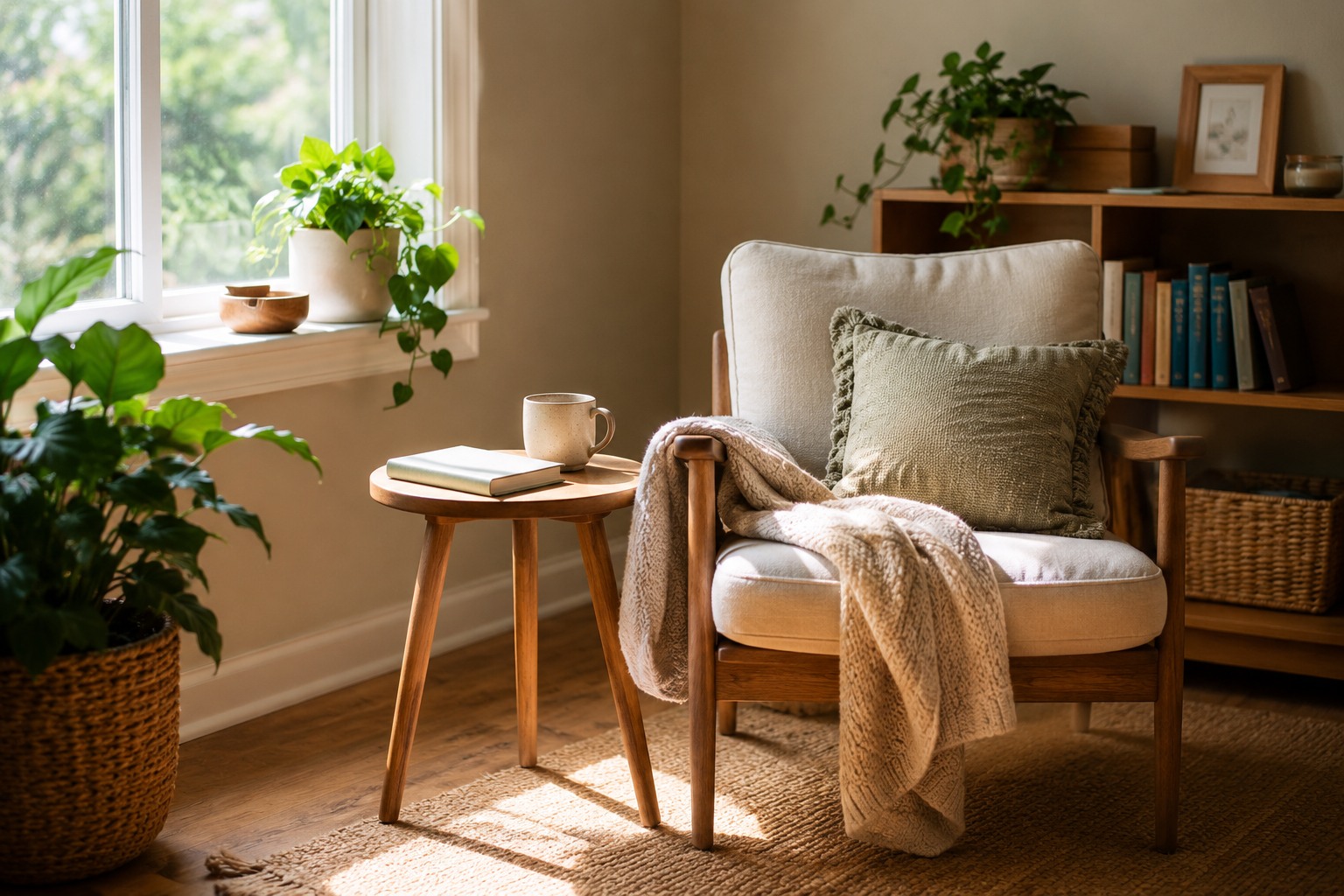
A comfortable chair.
A reading lamp.
A favourite blanket.
A quiet corner for tea.
Or simply a dining table that is cleared after meals.
These spaces can become gentle invitations to pause and recover.
Rest doesn’t always require extra time.
Sometimes it simply requires permission.
Let Your Home Tell Your Story
Wellbeing isn’t created by copying someone else’s style.
It’s created when our homes reflect what matters to us.
Family photographs.
Children’s artwork.
Books you’ve actually read.
Travel memories.
A handmade quilt.
A favourite mug.
Meaningful objects can help us feel grounded and connected to the people, places and experiences that matter to us.
A supportive home can feel more personal when it reflects the people who live there.
It needs to feel like yours.
Real Homes Aren’t Show Homes
Social media often presents homes that appear permanently tidy, beautifully styled and free from everyday mess.
Real homes are different.
They hold conversations.
They collect muddy shoes.
They witness celebrations and difficult seasons alike.
Your home doesn’t need to look flawless to support your wellbeing.
Sometimes making one chair easier to sit in, clearing one kitchen surface or opening one window is enough to change how a room feels.
The aim isn’t to transform everything.
It’s to notice what would make life work a little better — and begin there.
🌿 One Small Step
Choose one space you use every day.
Spend ten minutes asking yourself:
What is making this space harder to use well?
Then remove, move or simplify just one thing.
It might be a pile of papers, an overflowing basket or an object that no longer belongs there.
Don’t aim to transform the entire room.
Simply make today a little easier than yesterday.
And while you’re there, notice one part of your home that already feels comforting.
You don’t have to improve everything.
Just notice what works — and make a little more room for it.
Small acts of care can create homes that quietly care for us in return.
If this article offered you a useful idea today, consider sharing it with someone who might appreciate a gentler way to think about their home.
Only if it feels helpful — there is no pressure either way.
A note about wellbeing: The ideas in this article are intended for general wellbeing and practical reflection. They are not a substitute for medical, mental-health, sleep or other professional advice. If you have concerns about your wellbeing, consider speaking with an appropriately qualified professional.
The ideas shared in this article are informed by current research and recognised professional guidance. If you would like to explore the evidence further, the following summary highlights some of the key findings that helped shape this article.
Our physical surroundings can influence stress and psychological wellbeing through factors including noise, crowding, housing conditions and our sense of control over our environment.
Reference: Evans, G. W. (2003). The built environment and mental health. Journal of Urban Health, 80(4), 536–555. https://doi.org/10.1093/jurban/jtg063
Editorial note: This is a broad academic review covering housing, noise, crowding and design across many populations, rather than a study of everyday tidiness or home organisation specifically. We draw on its broader finding that physical environments can meaningfully affect stress and psychological wellbeing, rather than using it as evidence for any single household organisation recommendation.
Research into restorative environments suggests that contact with natural elements can support stress recovery and attention. Natural light, views of nature and simple natural elements may therefore contribute to how restorative a space feels.
References:
Ulrich, R. S. (1984). View through a window may influence recovery from surgery. Science, 224(4647), 420–421. https://doi.org/10.1126/science.6143402
Kaplan, S. (1995). The restorative benefits of nature: Toward an integrative framework. Journal of Environmental Psychology, 15(3), 169–182. https://doi.org/10.1016/0272-4944(95)90001-2
Editorial note: Ulrich’s study examined hospital patients recovering from surgery and compared views of trees with a brick wall. It was not a study of homes. We have included it because it is foundational to the wider research on restorative environments, rather than as direct evidence for specific household recommendations.
Making a helpful behaviour easier to do can increase the likelihood that we will repeat it. This supports the simple idea behind many of the practical suggestions in this article: sometimes changing the environment can be more useful than relying on motivation alone.
Reference: Fogg, B. J. (2020). Tiny Habits: The Small Changes That Change Everything. Houghton Mifflin Harcourt.
Editorial note: This is a popular behaviour-change book based on Fogg’s research programme at Stanford rather than a peer-reviewed journal article. It is included as an accessible source for the broader behavioural principle that making actions easier can support behaviour change.
Why We Wrote This
Many people believe wellbeing begins with having more time, more money or a bigger home.
We don’t believe that’s true.
We wrote this article because we believe a supportive home begins with noticing what is already around us and asking what could make life a little easier.
A supportive home isn’t built in a weekend.
It’s shaped through the small choices that help us care for ourselves and those we love.
Continue Your Simple Home Journey
There is no perfect way to create a supportive home.
Explore the Simple Home collection for more thoughtful ideas about creating spaces that feel calmer, lighter and easier to live in.
Thank you for spending a few moments here today.
A Gentle Reflection
As you look around your home today, resist the urge to notice everything that still needs attention.
Instead, find one corner that already feels like yours.
Then ask yourself:
What could I change, even slightly, to help another corner do the same?
You don’t have to change everything.
Sometimes one small act of care is enough to begin.